Monday, November 21, 2011

The State of the Industry: Wind Making Important Gains, Facing Legislative Uncertainty

Workers preparing the base for
Turbine at Chesapeake college in
Maryland
Of all the renewable energy technologies available, wind energy appears to be the one most capable of being harnessed to a true utility scale. Cumulatively, wind energy production has soared 30% in the last ten years. The Global Wind Energy Council tallies the number of wind energy jobs at over 400,000. Within the last decade large wind farms have begun to dot the nation, particularly in the Midwest and Deep South, where strong winds and open country both exist in optimal quantities.

Wind has become a part of many conventional utility companies’ portfolios where it has proved to be anything but unreliable. During the scorching summer heat of 2011, Texas electrical grids buckled under soaring demand and conventional modes of production could not keep pace. Wind turbines picked up the slack and kept the air conditioning and lights on in thousands of Texas homes.

While the wind sector has experienced its share of the attrition from the global economic downturn, the worldwide wind picture appears strong, with European markets stable and China claiming the top spot in terms of global wind energy production.

On the other hand, the United States has seen its share of production in the wind sector decline by half in 2011. This year has seen the nation’s first planned offshore wind farm, Cape Wind, struggle with bureaucratic red tape and a fierce backlash from citizens concerned with the sight, sound and placement of the turbines. These factors, combined with wrangling on behalf of the utility companies and lawsuits have caused the gears of Cape wind to grind to a halt.

More menacing is the prospect that Congress, (who recent polling shows is tied with Hugo Chavez at 9% for popularity among American citizens) gripped by the hysteria of austerity, will decide to scale back or entirely dispense with the federal grants making much of utility scale wind possible. If this happens, analysts and industry leaders predict that, while it will not kill the wind industry in the United States, it will greatly slow its advance.

At a time when the nation badly needs jobs, it makes little sense to gut the funding from an internationally growing industry. It goes beyond poor judgment and into the realm of outright cruelty, when one takes into account the thousands of Americans who will lose their jobs should Congress decide to remove these important and necessary subsidies.

Contrary to what some would have us believe, the oil, natural gas and especially the nuclear energy sector all had substantial subsidies, grants and miscellaneous perks afforded them by Congress in efforts to turn them into the behemoths of industry they are today. At a time when Marcellus Shale is generating revenue hand over fist, it is nonsensical to advocate for the retention of subsidies for the fossil fuel industry while demanding that government cut aid to clean energy.

On November 2, 2011, bipartisan legislation was introduced in the House of Representatives to extend the renewable energy production tax credits. The legislation is H.R. 3307: “American Renewable Energy Production Tax Credit Extension Act of 2011.” I strongly urge anyone who reads this post to write, email or call their congressman or congresswoman and urge them to cosponsor this bill and demand that they advocate for America’s rightful clean and renewable energy future.

- By Richard Harrod

Saturday, November 19, 2011

Solar and Wind Expo wraps up in Massachusetts – Part Deux

Ted Dillard showing his
electric motorcycle
The 2012 Massachusetts Solar and Wind Expo will be held the first weekend of November in the Royal Plaza Trade Center in Marlborough. We are looking forward to growing the number of vendors at the show and people walking through the door by expanding on our advertizing campaign, engaging our current partners early and adding more.

Although the Expo is not for another year we stay engaged in the Massachusetts energy community and will continue our mission of promoting renewable energy any way we can. One of those ways will be to point out misinformation and injustice anytime we see it.

I recently read that the Alliance to Protect Nantucket Sound, a Cape Wind opponent, has recently received a large contribution so it can continue to fight this much needed and good-for-everyone project. A quick search on Wikipedia revealed the following: The Alliance to Protect Nantucket Sound is a 501(c)(3) nonprofit self-styled environmental organization dedicated to the opposition of the Cape Wind project[1] and to the long-term preservation of Nantucket Sound.[2] Alliance membership and allies include wealthy residents of Cape Cod, executives in fossil fuel industries, some local towns, Chambers of Commerce, several environmental groups, many fishing and recreation groups, and public figures including billionaire oil heir William Koch, former mining executive Doug Yearley, former candidate for U.S. President and former Massachusetts governor Mitt Romney, the late U.S. Senator Ted Kennedy, Attorney General Tom Reilly, and Congressman Bill Delahunt.[1][3][4] Its current president is Charles McLaughlin of Harwich. Among its directors have been Dan Wolf, President and CEO of airline Cape Air, along with former candidate for Massachusetts governor and convenience store baron Christy Mihos (source: public records at the Massachusetts Division of Corporations).
A self-styled environmental organization dedicated to the opposition of the first offshore wind farm? Cape Wind is a project that is decades behind the rest of the world and would create many short and long term jobs as well as reduce our dependence on fossils. That is why the Solar and Wind Expo will continue to do its job: Pointing out issues like this, promoting and creating demand for renewables until we no longer need fossil fuels and beyond.
Vadim Polikov of Astrum Solar
demonstrates solar power to
a very interested attendee to the
Mass. Solar and Wind Expo
I want to thank the folks who helped make the Expo a success. They were instrumental in spreading the word and believed in us from the beginning:
And the many who attended and are now evaluating their energy choices
Look for future blogs where we’ll tell you about plans for the 2012 Maryland Expo. We are putting together more seminars, more EVs--including the first ever Electropalooza. Electropalooza will showcase factory and homemade electric motorcycles and cars and their capabilities on a closed circuit track. Don’t miss it. Save the date!
George Lopez


Wednesday, November 16, 2011

The Solar and Wind Expo wraps up in Massachusetts and now looks to Maryland


The kids had fun on
Ted Dillards Custom

It was a beautiful weekend in Marlborough, Massachusetts, on November 4-6th. Over 2000 people interested in renewable energy came through the door and were welcomed by solar and wind energy companies, Segways, electric cars, an electric motorcycle and electric bikes.

The free seminars were very popular and all classes were well attended. The most popular classes were those on solar leasing, wind and geothermal.

The weather cooperated the entire weekend had sun and temperatures in 60s. A week earlier they had a 30-inch snowfall and all was melted by the time we arrived. The folks at the Royal Plaza Trade Center were great and treated us very well. The guys at Capital Convention Services even threw in the wall-to-wall carpeting. We extend a big thank you to Pat Silva and Erik Palm and the entire staff of the Trade Center.

A week earlier due to the storm Massachusetts had been hit with a massive power outage and the Hotel had become one of the staging areas for the reconnection efforts. While folks on TV lamented about how the electric company was not doing enough, we were treated to an incredible demonstration. I have never seen so many boom trucks in one location in my life. The parking lot had generators running around the clock with staging area for poles and other needed items. The lobby was deployment central for hundreds of workers from all over the country. The poor guys had to take their clothes with them every day because they did not know if they would come back to this hotel or another. By the time the Expo began setting up, the entire state of Massachusetts had power. My hat goes off to National Grid and all the guys who gave their all to get it done.

Now we focus on Maryland and the plans are taking shape. We are putting together a great event, bigger and better than last year. The first ever “Electropalooza” will take place in May along with the Expo. We are expecting electric motorcycles and cars from all over to descend on Timonium Fairgrounds. Stay tuned.

George Lopez
 in our Key West Headquaters.

Wednesday, November 2, 2011

The State of the Industry: Ray of Sunshine Winds its Way through Pennsylvania State Legislature

Over the past year Pennsylvania has been a tough spot for the solar industry. Solar power benefited greatly from the enacting of the Pennsylvania Sunshine Program in 2008, which created a $100 million fund for residential consumers and business owners to tap into to help offset the cost of going solar.

This created a boom in solar installations, but now the fund is all but depleted and state has outpaced its renewable portfolio standard carve out for solar, meaning that the value of SRECs (the certificates or credits generated based on kilowatts of solar installed and then sold back into the grid) in Pennsylvania has tumbled from over $300 to around $50 over the last year.

This crash of SREC prices and disappearance of subsidies is compounded by a less than proactive approach from the Governor’s Office in Harrisburg. Governor Corbett has focused almost all energy policy on the exploitation of natural gas from Marcellus Shale. Additionally he has banned state agencies from investing in infrastructure upgrades or repairs that involve the use of renewable technologies.

Many companies are diversifying or relocating, opening offices in more renewable energy friendly states like New Jersey or Massachusetts or simply leaving the state altogether. The state’s share of solar jobs has gone from near 7000 to under 5000 in the course of one year.

The one ray of sunshine in this landscape is coming from a new proposed law entitled “Alternative Energy Portfolio Standards Act” (HB 1580) sponsored and promoted by State Representative Chris Ross (R – Chester County). The bill would increase the solar carve-out in the Pennsylvania’s RPS to .5% and also close the state’s borders to purchases of SRECs from outside Pennsylvania.

Rep. Chris Ross
Rep. Ross has been buoyed by a tremendous amount for support. Legislators were signing on as cosponsors before the legislation was even written. As it stands now, the bill is before the Consumer Affairs committee. It is not known for certain when the bill will make it out of their deliberations and to a vote on the assembly floor, but experts in the industry believe it will not only pass, but will also be signed by Governor Corbett if it makes it to his desk.

HB 1580 is a very promising initiative and, assuming it passes, should stabilize the solar industry in Pennsylvania. It will take longer for the industry to undergo the necessary market shakeout and for supply to come into line with demand. Nonetheless, it is more than a little encouraging to see local lawmakers fighting for the jobs and welfare of the solar industry and understanding the promise that renewable energy holds, not just for Pennsylvania, but for the United States and beyond.

- by Richard Harrod

Monday, October 17, 2011

Annapolis Boat Show - Part Deux - The Power Weekend

Can one expect Green initiatives at a power boat show? Well, yes, particularly on the shores of the Chesapeake Bay. The US Powerboat Show held in Annapolis last weekend showcased a few enthusiastic vendors that offered sustainability as well as performance.

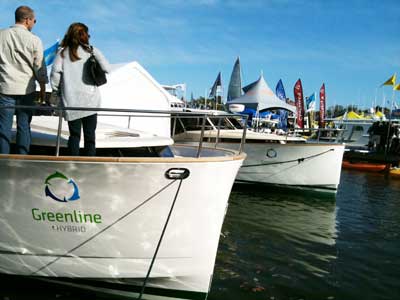
Greenline Hybrids
Most notable in the water was the Greenline Hybrid, two beautiful and comfortable boats made in Europe. What sets them apart is the company’s philosophy: “We want to keep our most beautiful boating spots in the same pristine condition as when we first discovered them. We want to enjoy the untouched beauties of the boating world for years to come and pass them on to our children and grandchildren.” To fulfill this vision, they have devised a hybrid engine that allows cruising on the sun’s energy supplemented by diesel power when needed. Running on solar electric power enables a quiet, pollution-free ride, much like the sailboat experience, at sailboat speed (up to 6 knots) – up to 20 miles at 4 knots. When it is necessary to get somewhere quickly, such as trying to outrun a storm, the diesel can be kicked in increasing the speed up to 15 knots. 

Greenline's 40 Hybrid

The charge from the six 1.3kW solar panels built into the hard top, and the hybrid drive that charges the lithium batteries when the diesel is running or the sun is shining, allows the boat to run for several days without the diesel. The solar panels have been built to operate in a marine environment and they can be walked upon. The manufacturer says that due to the design of the hull, the boat burns “…up to 4 times less fossil fuel per nautical mile than comparable planning hulls, reducing the pollution by 75%.” Both the 33-footer and the 40-footer are impressive vessels that make a very strong environmental statement (greenlinehybrid.com).

Electrocruise
On a smaller scale, the 23-foot ElectroCruise solar-assisted cruiser was in the water equipped with solar panels that power a Ray Electric 4HP outboard. The little lobster boat hulled cruiser has a hardtop covered in solar panels and depending on the number of batteries installed can cruise up to almost five hours at 7 knots. The full line of “e-boats” is designed for all-day electric power cruising with a range of up to 12 hours on a single charge, depending on the model. The electric outboards, ranging from 2.5 to 4HP are made in the USA. The Ray Electric is, according to the manufacturer, “the first electric outboard to be designed and patented as a primary source of power,” rather than just for trolling. Coupled with the charge from the sun, use of the electric outboard makes for a relaxing, non-polluting, quiet ride (rayeo.com).
Ray Electric Motor

German-made, Torqeedo displayed its line of electric outboards, lithium batteries and distinctive propeller design. Models ranged from kayak motors to those that can take provide almost 10HP. The system includes a remote throttle information display that details battery charge status, remaining range, speed over ground, and input power (torqueedo.com).


Duffy Electric Boats
Locally, SJ Koch Electric Boat Rentals displayed its incredibly cute rental American-made Duffy Electric Boats, that are not solar powered, but electric plug-ins. These quiet little boats hold up to 10 people for a quiet day on the water and are rentable in three locations in Maryland (experiencetheduffyboat.com).
Green on shore transportation was featured too with Bikes Go Green, a family-run business from Virginia. Their foldable Volto bikes, made in China, operate by traditional pedaling or electrically via a lithium-ion battery powered motor. Either way, they are emission free (bikesgogreen.com).

Bikes Go Green

Of course, there’s the other side of the coin too – the mega-motored muscle boats that probably use more fuel in one afternoon than the average neighborhood. There was one outboard that produced an astounding 537HP and looked to me like it was dressed in a Superman outfit. Even so, there was a lot of talk about fuel efficiency.

The boat show management is slowly moving toward recognition of the importance of sustainability. The show brochure marked off an area for green boating where several of the dealers mentioned above were located. The management is awaiting a waste audit of trash collected during the sailboat show the previous weekend, so we are hopeful that there will be some recycling stations available next year in and around the show.

At both the power and sail shows, there is a growing appetite for sustainability and stewardship of the Chesapeake Bay. We hope that boaters will support the manufacturers and dealers of these products thereby doing as we are at The Solar and Wind Expo – creating demand and building markets for green boating products. That is good for the economy, for clean air, clean water and healthy lives.

by Elvia Thompson


Friday, October 14, 2011

RECs should be divided into commercial and residential

Let’s take look at the use and intent of Renewable Energy Credits (REC). RECs are intended to make polluting energy producers pay a surcharge for continuing to operate in the manner that they do, the charge is undoubtedly passed on to the consumer of that energy. The money is later used to help pay down the cost of Solar panels, Wind Turbines and in some cases Geothermal and other clean energy methods. This is the most prevalent system in America.
SRECs in PA have crashed
over the last few years
( source - srectrade.com)

Every time your Renewable Energy system makes 1,000 kilowatt hours, it makes 1 SREC (the “S” is for solar in this case). You then sell the REC to the polluter and everyone wins. That is if the price of the REC is high. The RECs are traded in an open market, which in turn make them unstable.

In Europe they prefer feed-in tariffs, a policy mechanism designed to accelerate investment in renewable energy technologies. It achieves this by offering long-term contracts to renewable energy producers, usually based on the cost of generation of each different technology.

The first form of feed-in tariff believe it or not, was implemented in the US in 1978 under President Jimmy Carter, who signed the National Energy Act. This Act included five separate Acts, one of which was the Public Utility Regulatory Policies Act. The purpose of the National Energy Act was to encourage energy conservation and the development of new energy resources, including renewable energy such as wind, solar and geothermal power.

Which system is better depends on who you ask and maybe even what political flavor they enjoy. The feed-in tariff is a policy that says we are going to do this and we are going to pay for it, for the good of our society. Germany has taken this approach and no one can argue that they are doing a great job with this system.

The REC market is different in that depending on what the credit is worth at the time of the energy systems sale and installation has a direct bearing on the sale itself. In other words when the price of RECs is down, the renewable energy system becomes more expensive.

It also stands to reason that this unstable market system has the ability to delay the nations conversion to renewable energy, because by making the consumer pay a higher cost today than yesterday is never a good idea and sends the wrong message. This is what happened in Pennsylvania. Unless of course that is what the intent was from the start.

One big flaw with the REC market system as it exists is that it does not differentiate between residential and commercial installations. In a commercial installation the amount of RECs that are made available to the owner, be it a renewable energy plant or a large commercial application is higher and quickly floods the market with REC paper. This in turn brings the value of RECs down and hinders the ability to buy and sell residential installations. The residential market could account for the biggest amount of installations in the US and also in the amount of jobs that could be created if allowed to flourish.

So it would seem to make sense to split RECs into two or more categories or maybe make the residential RECs worth a set amount across the entire US and make the mandatory percentage higher or unlimited. Another way is to make residential credit worth two or more times that of its commercial counterpart or make it so the commercial credits do not go towards the quota but are worth the same amount as the residential. The renewable energy industry is new and it needs to get proper support to continue to grow. This support must come from strong leadership and this is one suggestion that could help sustain the industry.

by George Lopez

Wednesday, October 12, 2011

Public Opinion seems to be oil and gas’ game

Last night I received an email from a friend asking my opinion of a graph that purportedly demonstrated that renewable energy is not worth the investment. This is not the first time that something like that has been sent to me. Why are so many people taking the time to produce such graphs and to rotate them around the net? What a waste of energy. Or is it?

It was a confusing graph with many curves and comments and made no sense whatsoever. But nevertheless, it was sure to make the over credulous think about keeping the status quo. However, the time for energy conversion is here and it is only a matter of time before we make the change. But it will take some work on our part. Sure we could make graphs that contend that renewable energy will make your hair grow back and that it will make the price of college education go down, but that is not necessary.

The tide has turned already. In watching the republican debates, it is refreshing to see the candidates speak about drilling, but staying away from falsehoods about renewable energy. They must know that tide of public opinion has turned in favor of renewable energy and to speak against would mean sudden political death.

Look around and you will see the change is happening. Spray insulation, low wattage bulbs such as LED, energy saving appliances and passive house standards are just a few of the things that are being implemented by those who want to be ahead of the curve. You have to believe that the cost of energy will always go up because historically that has been the way. Those who do not transition to renewable energy and electric transportation now will be the ones who feel the squeeze later.

That is the important message we should be giving to those who say renewable energy is not worth the investment.

Turn on the TV today and you get a confusing collage of clean natural gas, coal and gasoline efficient vehicles while some of the same companies are touting turbines and electric cars. The change is here and all of us should embrace it together and now.

Mitsubishi is beginning to promote their electric cars as is represented in the following video, joining the ranks of the LEAF and the VOLT. They will soon be joined by BMW, FORD and others, the future is here, don’t stay in the past.

 by George Lopez